Books
Jason Cherry
Jan 12, 2026
Introduction
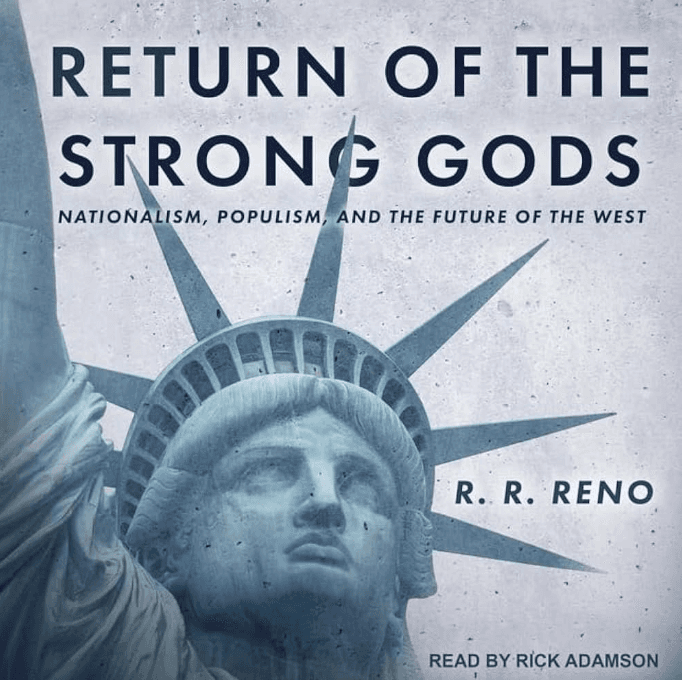
Today, every podcaster grasping for followers complains about the postwar consensus (PWC), a phrase coined by Rusty Reno in his book, Return of the Strong Gods. So, I decided to go to the source and find out what Reno is talking about. One conclusion after reading the book is that the podcasters who complain about the PWC the most are the ones who, apparently, haven’t read Reno’s book. They would do well to follow Reno’s proposed solution, which probably starts by them voluntarily shutting down their podcast. In particular, the people who reduce the world to sociobiological dynamics of clan behavior are engaging in the same cold analysis from below that is the hallmark of the PWC. In contrast, the hallmark of Christianity is a rousing truth claim from above.
With that introduction, let’s get on with the book review.
What are the “strong gods”?
What does Reno mean by “strong gods”? “The strong gods are the objects of men’s love and devotion, the sources of the passions and loyalties that unite societies. They can be timeless. Truth is a strong god that beckons us to the matrimony of assent. They can be traditional. King and country, insofar as they still arouse men’s patriotic ardor, are strong gods. The strong gods can take the forms of modern ideologies and charismatic leaders. The strong gods can be beneficent. Our constitutional piety treats the American Founding as a strong god worthy of our devotion. And they can be destructive. In the twentieth century, militarism, fascism, communism, racism, and anti-Semitism brought ruin” (xxiv).¹
Strong gods are whatever inspires love, such as “Love of the divine, love of truth, love of country, love of family” (139). To qualify as a strong god, it must be a love that “impels us outside ourselves, breaking the boundaries of me-centered existence” (139). “The strong gods of public life are quite simply the objects of our shared loves. They are whatever arouses in us an ardor to wed our destinies to that which we love” (139).
What is the relationship between the strong gods and the PWC? The goal of the PWC is to transcend ideology by creating policies based on social science (11-12). There must be no metaphysical claims and no substantive purpose to life (18). In other words, there must be no strong gods. This vision was cast by Karl Popper’s 1945 book, The Open Society and Its Enemies. His main concern was how to keep authoritarianism from resurging in society, how to keep another Hitler from taking power.
The PWC underwent a broadening and flattening with F.A. Hayek’s 1944 book, The Road to Serfdom, which does better than Popper because it has a much narrower economic aim. He casts a vision for the superiority of the market economy over communism. Yet, Hayek stands on the same foundation as Popper, with a rejection of metaphysics. Hayek promotes autonomy, or a version of individualism, the essence of which is that each person is “the ultimate judge of his ends” to decide what is good or bad for me, not based on any transcendent reality, but on increasing my social utility (21).
The PWC centers on disenchantment, opening borders, and weakening moral boundaries (xxiii). Closed borders equal Auschwitz (130). The PWC is concerned with getting rid of sacred foundations and shared loyalties (138). The fundamental judgment of the PWC is that “whatever is strong—strong loves and strong truths—leads to oppression, while liberty and prosperity require the reign of weak loves and weak truths.” If there is a strong, then there must be a weak. When Reno speaks of weakening, he refers to a strictly materialistic worldview that produces relativism, sociobiology, economic analysis, diversity, inclusion, sexual perversion, and globalism.
The Circle of Totalitarianism
Ironically, the goal of Popper’s open society was to end totalitarianism, yet the result was totalitarianism. Why did it work out this way? Why did the PWC’s opposition to totalitarianism lead to a new oppression? Why did their weakening of the strong gods become a Mephistophelean strong god? It’s because the battle against ideology quickly turns into an ideology. The struggle against loyalty quickly earns people’s loyalty. The erasure of ultimate truth quickly becomes the ultimate truth. The destruction of religion quickly becomes a religion.
When you remove the One True and Living God, when you build society without any metaphysics, or Natural Law, or Bible, or human nature, or ordered loves, when your imperative is “never again,” then you must insist that it is forbidden to forbid, because the people who forbid are like Hitler. They must be censured and silenced. Put again, according to Popper, transcendence is oppression because it savagely imposes its truths on humanity (55). Popper’s logic is foundational quicksand, and it’s stunning that in the last seventy-five years, the American leadership class has tried to make its stand on it.
There is an unforeseen and savagely ironic outcome to the PWC. That which hoped to withstand totalitarianism has created it. By flipping the script so that authority comes from the bottom up rather than the top down, the sources of authoritarian control have been rearranged rather than restrained. When Karl Popper calls for social scientific governance, or John Rawls calls for public reason, they are referring to data-based arguments that often present as “studies.” Their goal is to “restrict ourselves to the universal truths of science, especially the social sciences, which purport to be value-neutral” (81).
What is the consensus of the PWC?
The consensus is that if you remove truth claims, you remove the causes of divisive loyalty and forestall authoritarianism (50). Thinkers such as Karl Popper, F.A. Hayek, Albert Camus, Jacques Derrida, and Milton Friedman, while appealing differently to the Right and the Left, all agree that society must pursue disenchantment. This is why, for the last eighty years, on the ultimate questions, the Republicans and Democrats have agreed to the ongoing critical analysis that disenchants. The result of each political program is that there are no worthy objects of loyalty and love. For the Democrats, the highest truth is cultural deregulation. For the Republicans, the highest truth is economic deregulation. Both agree that the one thing that can’t be permitted is truth claims from the God of the Bible. Metaphysical poverty must be maintained. Anyone who makes ultimate truth claims is a neo-fascist.²
What is the PWC’s foundation?
The foundation is value-neutral science. Social science, or economic science, or political science becomes the privileged claim, the foundational assertion, the numinous presence, even as the PWC denies metaphysics. Notice the performative contradiction. They’ve rejected the tyranny of ultimate truth claims with ultimate truth claims. Now, they wouldn’t dare call their project an ultimate truth claim, because such a claim would make them crypto-fascists. But when they refer to hundreds of studies, data sets, and scientific facts, they expect this to be received as the unassailable conclusion. This is the very sort of definite epistemological claim they are trying to withstand. So, the method of the PWC depends upon the very thing it denies, the possibility of real knowledge, the ability to grasp meaning, and the capacity to make true claims about reality.
For others, the foundation is diversity and identity politics. The more diversity was celebrated, the more people gravitated toward their “identity.” This is understandable. People want, people need, a shared loyalty. Because they are deprived of the strong gods, they create solidarity based on race, sex, sexual orientation, and other identities.
What is the result of the PWC?
Reno argues that the PWC leaves people homeless, anchored to nothing, part of nothing great, nothing enduring, nothing worthy of admiration. It erases family history and marital fidelity. People are homeless in that they are expected to eat pabulum and like it. They are taught to tear down anything worth standing. Reno writes, “This is our crisis: a disquietude born of homelessness” (103).
So, that means our current crisis was created by the PWC. What current crisis, you ask? Marriage is collapsing, boys use girls’ bathrooms, drug overdoses decimate communities, leaders push for the legalization of gambling and marijuana, the suicide rate rises, doctor-assisted suicide rises, and the church conforms to the sexual revolution. Yet, all the leadership class sees is discrimination, exclusion, and bigotry, which are inadequate as ends in themselves (143f).
PWC and Hitler
The PWC arose as a direct response to the authoritarianism of WWII, especially Hitler. One reason the PWC has failed is that they got Hitler wrong. Hitler was, of course, authoritarian, and he, along with Stalin, is absolutely the villain. But the proponents of the PWC react to that by saying that anything that engenders strong loyalties, like Hitler, tradition, religion, family, or nation, must be done away with. Hitler is branded as a nationalist who lured the German people to love their nation too much. But is casting Hitler—Hitler!—as a facilitator of too strong a love an accurate historical assessment?
For all of Hitler’s blustering about love of country and love of Germany, he proved to be the greatest enemy to Germany. His actions as the Führer systematically destroyed Germany. The German church was in stage four cancer because it prostituted itself to theological liberalism. Nazifying the church put it in the grave. The young men of Germany were killed off, an entire generation of men sacrificed for Hitler’s territorial delusions of “blood and soil.” The moral authority of Germany was forfeited when they rounded up and killed the “deplorables” in mass, mainly the Jews. The Nero Doctrine of scorched earth that finished off Germany and destroyed it once and for all means that Hitler is not a loving father who is self-sacrificing to protect his family. He is the baleful father who kills his family in a murder-suicide. If the father left a note insisting he slaughtered them out of love, any sane detective would dismiss it as the words of a selfish loggerhead.
Hitler’s love of country doesn’t explain Germany’s share in the guilt of World War II. And similar things are revealed when you survey the other belligerent nations. For example, Stalin, the leader of the USSR, was driven by an ardent internationalism rather than nationalism. The reason we have to slow down and think about Hitler is that it’s not just the PWC that has gotten Hitler wrong. Now, Hitler-love is back. People see that the PWC is bunk. In this, they aren’t wrong. It’s plain as day. The reactionaries to the PWC (and their bots) have said, “If the PWC is wrong, maybe that means Hitler wasn’t such a bad guy. He’s been misunderstood.” And so, these reactionaries, under the influence of some strong excitement, engage in Hitler rehabilitation. This pro-Hitler reaction to the PWC, alarming and avenging as it is, requires special and rather grave consideration. In particular, Hitler fanboys seem unaware that they make themselves just like those they oppose, the creators and supporters of the PWC.
The deeper cause of differing opinions is more similar than the differences themselves. Each side has a strong reaction to Hitler that misses the mark. Each is interested in preventing the rise of authoritarianism—the PWC being concerned about Hitler-type totalitarianism and the Groypers being concerned about the post-PWC woke tyranny. Both sides, no matter how noble their views are made to sound, feed an unnatural view of life, namely, the PWC eliminating metaphysics and the Groypers wondering if a certain mustached murdering madman wasn’t so bad.
The PWC, for all its components, including free markets, weak borders, and multiculturalism, has at its heart a rejection of any ultimate truth claims. By rejecting metaphysics, the PWC ended up breaking all the shields and weapons ordinary citizens had to defend themselves from power.
And this is why the PWC has failed, even as free trade and unlimited immigration deserve different estimations. A rejection of metaphysics indicates a lack of interest in life as a thing to be lived, as if love letters, private emotions, or human happiness are unnecessary excesses to human existence. Then there is Hitler, who held as his chief heresy the fundamental falsehood that there could never be a Fate or Providence outside his control. The recent movement of Hitler-love is full of moral stunts and scoops, intellectual bargaining, and self-promotion. It is a world as spiritually dead as the world of the PWC, also rejecting metaphysics, only in a coarser form. As René Girard taught us, rivalry really does eliminate differences.
What this reveals is that just like the perverse strong gods of blood, soil, and identity won’t be overcome by the open-society therapies of weakening—multiculturalism, immigration, and globalism (153), neither will the PWC be overcome by a revival of blood, soil, and identity. Something else is needed.
Conclusion
Reno says, “The crisis of solidarity threatens the West and fuels populism” (xxvii). This is why America is broken into hundreds of tribes, where each person skitters off to find their new shepherd, usually an inflammatory podcaster, and their new people, always online and usually supplemented by a large number of bots.
The PWC leads to “never-ending critique, the spontaneous order of the free market, technocratic management of utilities, and the other therapies of weakening.” The reason this fails is that “Disenchantment will not make our society more humane and hospitable.” The open society has become the enemy of shared loves and anchored convictions, be they spiritual, cultural, or political. Humans “desire to live shoulder to shoulder with our fellow man in the service of shared loves.” To destroy the strong gods requires destroying love and solidarity. Thus, the PWC is anti-human (139-140). It turns out you can’t build a home without walls.
People need shared loves that include transcendent ritual, local civic bonds, definable cultural inheritance, and a “normal” social landscape where the family is indispensable to the moral imagination. For this to happen, people need the strong gods. Not just any strong gods, but the right ones. Rebuilding shared loves starts with nurturing the local church and marriage (159). No more can people be deprived of ennobling loves (159).
Reno ends his book with these words, “Our task, therefore, is to restore public life in the West by developing a language of love and a vision of the ‘we’ that befits our dignity and appeals to our reason as well as to our hearts. We must attend to the strong gods who come from above and animate the best of our traditions. Only that kind of leadership will forestall the return of the dark gods who rise up from below” (162).
Passivity leads to death. Active love leads to life. It’s time to stop dying. Every church that is paying attention should see the damage wrought by the PWC and have a ministry that teaches and inspires people to renew their shared loves and unifying loyalties under the Lordship of Christ. This is what the orphans and bastards produced by the PWC need the most: Worship of Jesus Christ, real fellowship with the body of Christ, and a moral imagination that is centered on the household, as G.K. Chesterton said, “Loyalty in the family is the chief security for liberty in the state.”³
Jason Cherry is an elder at Trinity Reformed Church in Huntsville, Alabama, as well as a teacher and lecturer of literature, history, and economics at Providence Classical School in Huntsville. He graduated from Reformed Theological Seminary with an MA in Religion and is the author of the books The Culture of Conversionism and the History of the Altar Call and The Making of Evangelical Spirituality.
Footnotes
¹ Page numbers will appear in parenthesis: R.R. Reno, Return of the Strong Gods: Nationalism, Populism, and the Future of the West (Regnery Gateway, 2019).
² HT to Larson Hicks for pointing out that John Mayer’s songs "Belief" and "Waiting for the World to Change" are the ultimate, PWC anthems.
³ G.K. Chesterton, The Story of the Family (Ignatius Press, 2022), 224.